
Another mother: SOS Ambassador Amanda Martinez goes to Namibia
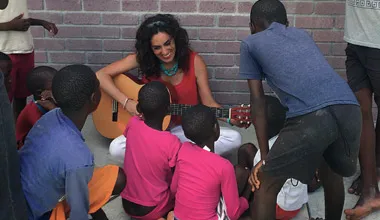
About Amanda Martinez
In January 2015, SOS Children's Villages brought Amanda to Namibia, a country just west of South Africa, where there are three SOS Children's Villages. There, Amanda became an SOS mother to eight orphaned and abandoned children while a camera crew filmed her experiences. Music and family are the two things that Amanda holds dearest to her heart. She lives with her husband and their three young children in Toronto, Ontario.
"Being a mother, whether in Canada or Namibia, is the most rewarding and challenging job in the world. Parents are the most important figure in a child's life. They are the source of a child's love. They shape who the child becomes ."
Amanda cultivated a taste for music at an early age, but it wasn't until after earning her master's degree in international business that she decided to pursue music as a career. In 2001, during her lunch break, Amanda had an epiphany and left her successful banking career to focus on singing.
Her music blends her Mexican and South African roots with flamenco soul, earning her three Latin Jazz Artist of the Year nominations at Canada's National Jazz Awards and Toronto's Independent Music Award for Best World Music Artist. Amanda's contributions to Canada's cultural scene were recognized by the Minister of National Revenue, who named her one of the Top 10 Most Influential Hispanic Canadians.
While Amanda was in South Africa to perform for the 2010 World Cup Celebrations, her relationship with SOS deepened. She had recently visited an SOS Children's Village in Mexico and decided to give proceeds from the song she performed at the World Cup, 'Sueños Posibles' (Dreams that are Possible), to SOS Children's Villages. She also donates proceeds from the sales of her latest album, Mañana , to SOS Children's Villages. During January's journey to Namibia, she wrote a song dedicated to and inspired by the children she cared for.
"All children deserve to have the opportunity to thrive and reach their full potential. Unfortunately, millions of children around the world are born into circumstances where they don't have those opportunities, and SOS Children's Villages is giving these children their childhood back, I have seen it firsthand. "
Video playlist on YouTube. Excerpts from Amanda's diary below.
A warm welcome
When I first entered the Village, I was greeted with the most incredible welcome dance. A huge group of children – probably half of the Village – along with SOS mothers and staff, were waiting with big, beautiful smiles for my arrival. When I got out of the car, Elizabeth, the SOS mother of the family I was going to live with, gave me a big welcoming hug. Children were holding handmade signs with my name and waving miniature Canadian flags.
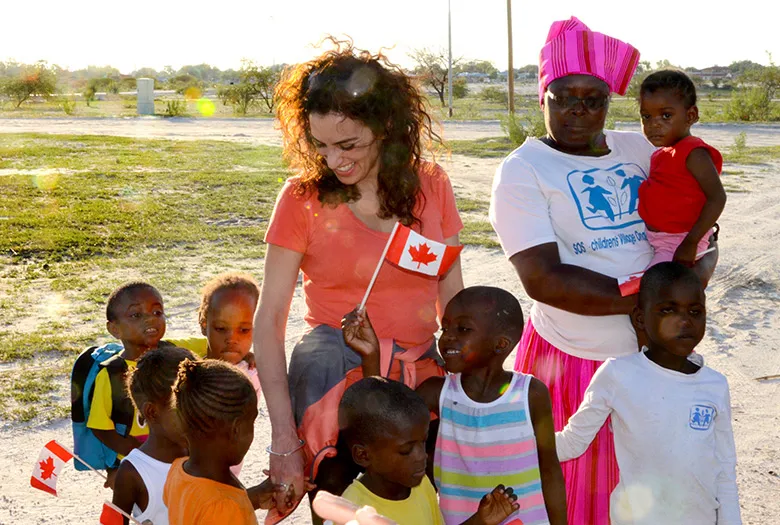
Children started performing traditional dances and singing songs, which I joined in. Although I had no idea what I was doing, their beautiful energy made me feel so welcome! After the celebration, the children from my SOS family took my hand to show me where I would be staying for the next week. It was really emotional for me - I felt so at home after only a few minutes – and I knew this was going to be a very special adventure.
A trip to the hospital
On my first day as an SOS mother, the youngest child needed to go to the hospital. This boy has a series of health problems that require constant medical attention. The visit with the doctor went well, but it was a long afternoon in the heat.
The hospital's reception area was outside, and when we arrived, there was a long line of people waiting to see the doctor. Being a mom in Namibia requires a lot of patience, and that is exactly what Elizabeth, the SOS mother, has. Just the heat alone takes a lot out of you. Healthcare is free in Namibia, but you have to be prepared to wait under the scorching sun.
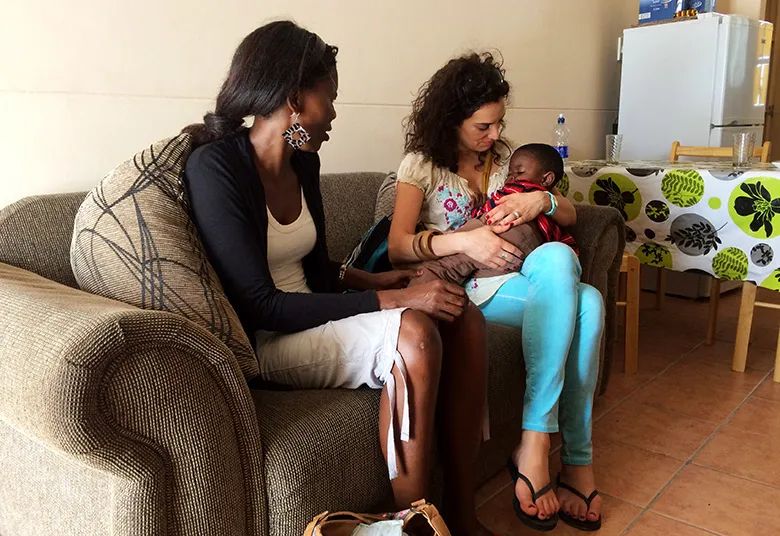
Since Elizabeth frequently takes the young boy to the medical centre, she knew how to work the system. It was unbelievable to see her maneuver her way to the front of the reception desk. We could have been there all day waiting, but she knew what to say and was very charming!
I have such admiration for Elizabeth and the way she handles things with such ease. Her ability to look after eight children and still focus on this little guy, who is always running around, is inspiring.
My daily schedule
To reduce chaos, Elizabeth runs her home on a strict schedule. Eight children mean eight morning showers, eight breakfasts and lunches to make, and eight kids she needs to get to school.
In Canada, my children wake up around 7:00 a.m. to go to school at 8:45 a.m. I generally get up around 5:30 or 6 a.m. to get ready and do some work before my children wake up. In Namibia, school starts at 7:30 a.m., so the children have to wake up by 5:15 a.m. every morning, not leaving Elizabeth much time to get things ready before they wake up!
Here is Elizabeth's morning schedule that I followed as an SOS mother in Namibia:
- 5:00 - Wake up.
- 5:15 - Wake up the children.
- 5:30 - Children's morning showers start. Children sweep their bedroom floors, iron their clothes, and get dressed for school. In the meantime, I start preparing oatmeal and boiling water for tea.
- 6:00 - Make fresh juice for lunch and add fresh fruit for the children's school snack. Children eat their breakfast.
- 6:15 - Children wash the dishes, and I check if any shoes need to be shined.
- 6:30 - Walk the younger children to meet their friends and walk to school together.
- 6:45 - Come back from walking the youngest children. Sweep the kitchen and prepare the evening meal.
- 7:00 - The rest of the children go to school.
- 8:00 - Make the youngest child breakfast and eat with him. Take my shower. Clean the toilets. Do Laundry.
A hundred stories
The SOS Village in Namibia is an amazing place. It provides over 100 orphaned or abandoned children with a home, a loving family and essential care. When you walk around the Village, you find a playground, an SOS Medical Centre, an SOS Kindergarten and a community outreach program for struggling families living outside the SOS Village.
I would describe the SOS Village as modest but very modern. It had warm running water, electricity, (shared) washing machines, and each home had a kitchen – all of the basic amenities. The home where I had the pleasure of living wasn't filled with material possessions, but it did have a television, which the children were allowed to watch when they came home from school. My eight kids always looked forward to watching Don't Mess with An Angel, a Mexican telenovela dubbed into English. They also had one wall in their rooms that they would decorate with photographs and posters.
In each SOS home, there was a wall in the living room or kitchen decorated with a handmade birthday calendar. The unique calendars featured a picture of each child and their birthdates in large writing, organized from January to December. I thought this was such a fun, creative idea that highlights every child in the home.
During my time at the Village, it was impossible to ignore the strong sense of family and community that surrounded me and each of the children living there.
Morning madness
It's funny to compare my mornings as a mom in Namibia with those in Canada. It felt as if my mornings were less chaotic at the SOS Village! In Canada, I am a mom to two-and-a-half-year-old twins and a six-year-old. At the SOS home, the youngest child is six, and the rest are between eight and 12. Most of the children are at an age where they don't need constant supervision. That being said, mornings were still pretty intense in Namibia!
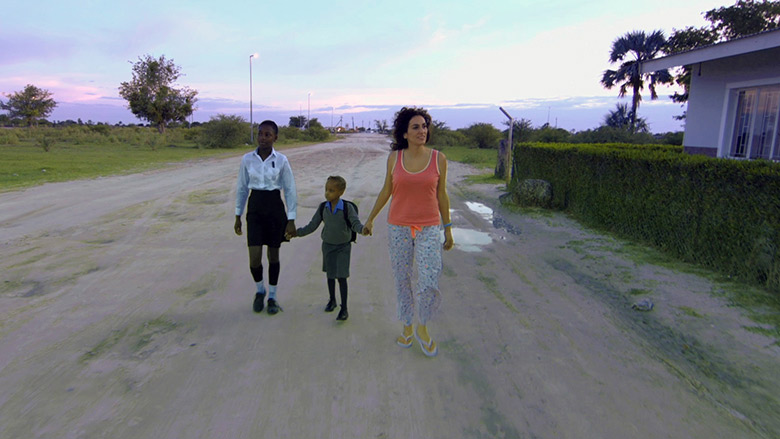
Each morning, the SOS children iron their school uniforms. The little ones needed my help with their ironing, which was the most challenging part of my morning. I am a little embarrassed to admit that I never iron clothes. I typically purchase clothing that you can throw in the dryer and that comes out wrinkle-free. When it was time for me to iron the kids' clothes, I think I took too long and didn't do it exactly the way they would have liked, but at least no clothes got burnt!
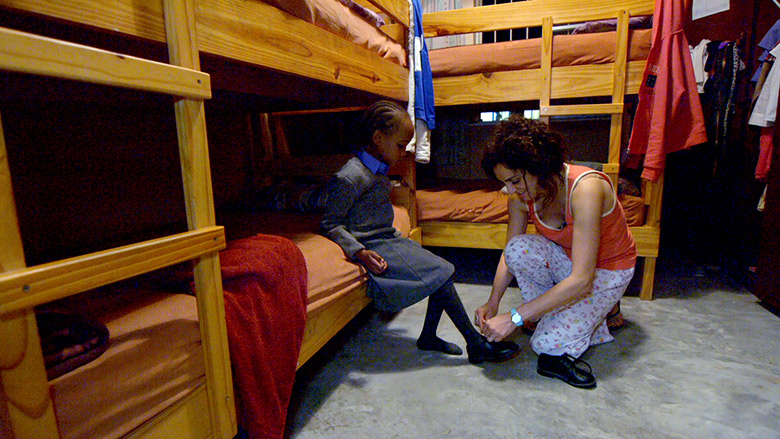
Aside from ironing and shoe shining, most of my morning tasks in Namibia are the same as those I do each morning in Canada. However, when you have eight kids – all asking you questions and working on a tight timeline – things do become hectic.
On my first morning, I had a sense of relief that everything was under control after I walked the children to meet their classmates. It was only when the eldest child, who goes to school last, reminded me that I still had to check that all the beds were made properly, clean the toilets, do the laundry, and make sure the youngest child got his morning egg that I felt a bit overwhelmed. It was nice to experience life as a full-time mom!
Sibling support system
On the first morning, I heard a little voice and a knock at my door at 5 a.m. "Good morning, Miss! We are going to make breakfast," the eldest child whispered in my room. She was my alarm clock that morning. I didn't know how my first morning would go, but she showed me the ropes!
In Toronto, my three children require more effort to get ready in the morning because they are much younger. These eight children were incredible as they got ready in the morning, and I could see how much they helped one another. The youngest child, who suffers from a series of medical conditions, needs to take medication every morning. Two of his siblings would hold him and calm him down, while another child gave him his medicine.
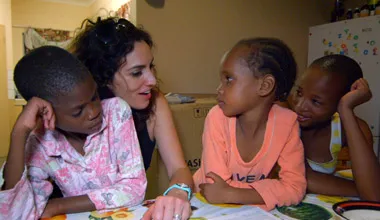
I wasn't expecting to see how self-reliant the children are, and I was really impressed by the pride they take in caring for themselves. One child said to me, "Um, Miss, are you going to iron your skirt?" Actually, I wasn't, but she gave me an amazing lesson in ironing, which I admit, back home, I don't do! The children are used to being so self-sufficient because, as a mother of eight, you cannot do everything. Elizabeth has done an outstanding job of raising these eight kids to take care of and look out for one another. You would never know that these children all came from different parents, as they are such a loving family unit.
Washing clothes for a family of nine
We may not all share the same washing methods, but every parent wants their children to have clean clothes. Before I arrived in Namibia, I was mentally preparing to hand-scrub nine family members’ clothes! But to my surprise, the home had its own washing machine, a luxury in any country, even though they share it with another SOS family.
The washing machine made things easier, but laundry day at the Village was still an adventure! The funny thing is that I don’t mind doing laundry. I actually do it every day back home in Canada for my family of five. The adventure started with the washing machine itself! To keep the electricity costs down, the machine cannot stay plugged in. So I had to unbox and haul the washer from the living room to the porch outside, where the water source was located. Then, I had to remember how to hook up the machine. At one point, the main hose started spraying everywhere because I didn’t fasten the hose tightly enough. But all the laundry got done in the end!
A 1950's lifestyle
Imagine a world where we can fully trust our children to be free outdoors, to play together without constant supervision, and to trust society that nothing will endanger them. Well, this is how the children at the SOS Village live.
When you enter the SOS Village you see kids playing in the field or playground, and enjoying the outdoors. It took me back to my carefree childhood and reminded me of 1950's sitcoms, where all of the children in the neighborhood played together outside.
The SOS children were not cooped up inside playing video games or watching television for five hours straight. They were outside enjoying the fresh air, playing basketball or soccer, or gathering the rest of the children for a game of hide-and-seek. A few mothers would watch the children, but not every mother was needed. The children were looked after in the Village as a whole, rather than individually, as we often do in North America.
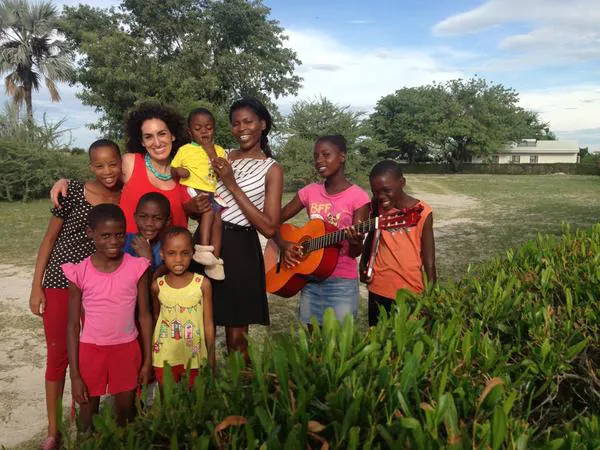
I found the SOS Children's Village to be extremely safe. The staff there took the necessary measures to ensure everyone was looked after and kept out of harm's way. Under that blanket of comfort and security, the kids are free to thrive and live life to the fullest. Back in North America, things haven't felt quite that way in a long time. This experience in the Village made me long for those days and wonder what it'd be like if kids living in large cities could play outdoors freely and safely with their neighbours once again.
Whitey the dog, the SOS Village mascot
When I arrived at the Village guesthouse, Whitey was lying on the road. As the Village Director and Whitey's owner, Charlton, came to greet us, my new canine friend lazily got up to allow Charlton to pass by. He did not have the energy of a puppy, but Whitey's eyes were kind and his hair a charming mess.
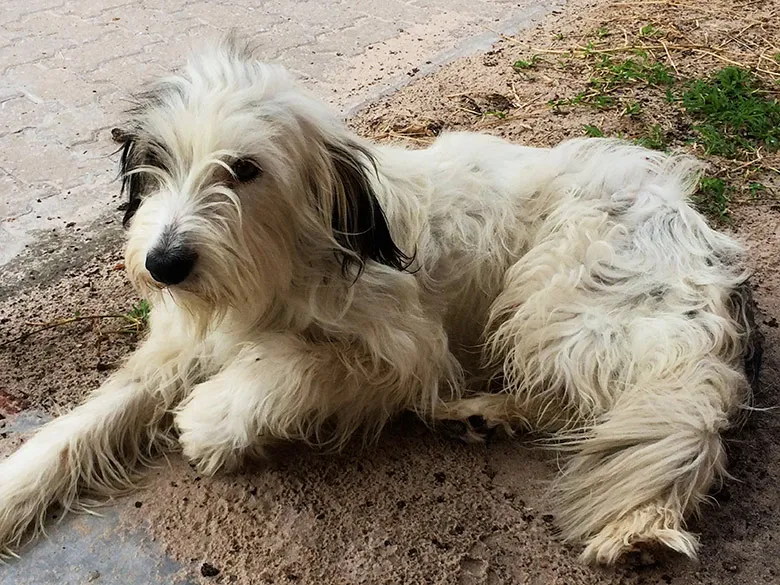
That was my introduction to the SOS Village mascot, who leads a life quite different from that of the many stray dogs roaming Namibia's streets. Whitey is one of the few exceptions. He has a loving family who looks after him and rubs his belly on demand. But even though he lives a happy and comfortable life in the Village, Whitey is still wild at heart! He prefers the open air, and you'll usually find him sleeping just outside the guest house.
Whitey was a constant, sweet companion during my time in Namibia. Every time we returned to the Village, I'd give him a friendly wave, and he'd be the first one to welcome me back! This special dog was just one of the many friendly faces that greeted me at the Village after a long day of housework and filming.
A trip to the market
Everyone kept mentioning how amazing the markets in Africa are, so I wanted to experience one for myself. We went to a local outdoor market that was just a short drive from the Village. To say the market was bustling is an understatement; it was swarming with people and lined with vendors selling fruits and vegetables, grains and every spice imaginable. American pop music blared in the background while crowds negotiated for the best prices. Most of the vendors and customers were holding umbrellas to shelter themselves from the sun. I had forgotten my hat, so I had to keep ducking into the shade! But looking at the market from afar was like a painting; it was bursting with the most vibrant colours!
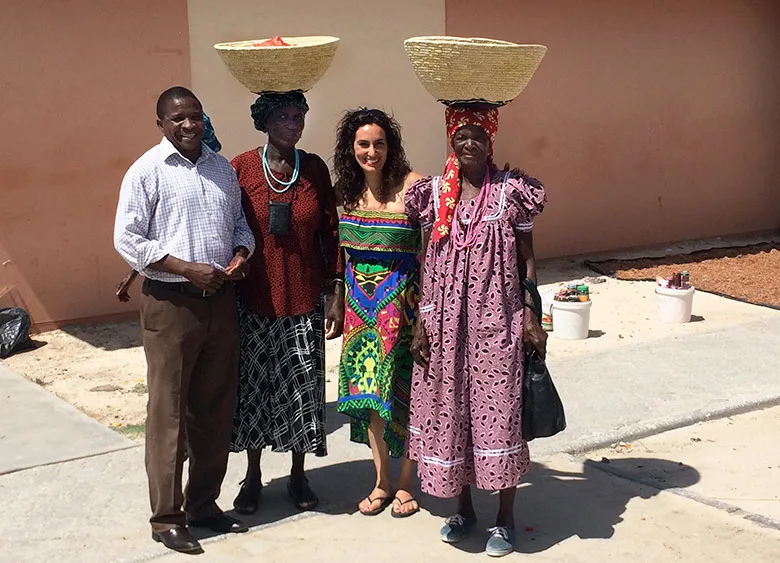
It seemed as if there was an unlimited supply of sorghum (more on that later), beans, lentils and yes, frogs. Charlton, the Village Director of Programming, accompanied me and explained that just after it rains, these frogs come out and, for a limited time, are not poisonous to eat. As much as I love frog legs, I could not convince myself to try one that may or may not be poisonous!! I had to pass on that delicacy, and the same went for the worms. As much as Charlton tried to convince me that they are a tasty local snack, I had to politely decline. The closest I have come to eating adventurously was in Mexico when I ate some fried ants and grasshoppers – chapulines!
Sorghum, the magic plant
Practically every third stall at the local market was selling sorghum. I had heard of this plant before, but in Namibia, I learned just how versatile and important it is in sub-Saharan Africa. You can make Sorghum into a flour, into ethanol, you can use it as a sweetener or feed it to livestock; so what exactly is it, you may ask? Well, sorghum can be used for all of these purposes and more.
This multipurpose plant grows as tall as corn in dry climates, making it a perfect crop to tolerate stressful conditions in sub-Saharan Africa. The plant's thin, waxy leaves have tiny pores that conserve water, and its roots grow deep in dry soil, increasing the sorghum's ability to extract water.
When I visited the SOS Family Strengthening program, I was introduced to a microfinance project where SOS provides support to vulnerable families. These projects teach caregivers how to run a business, make a profit and become self-reliant. One of the microfinance programs offered by SOS Namibia was the growing and selling of sorghum. Participants in the program sell sorghum flour at the market and also use it to make and sell bread.
Sorghum is not a wheat, meaning that it is gluten-free – another benefit of this magic plant. Since the vast majority of sub-Saharan Africa does not have mechanized farming, the process of turning the plant from grain to flour is tedious. First, you have to sort the grain, soak it in water until it has softened, and then pound it with a large wooden pestle. This process, which is repeated several times, removes the hard outer layer of the grain. It is then spread out to dry under the scorching Namibia sun. Once the sorghum has dried, it is hand-pounded repeatedly. The process is very labour-intensive and definitely provides a good upper-body workout!
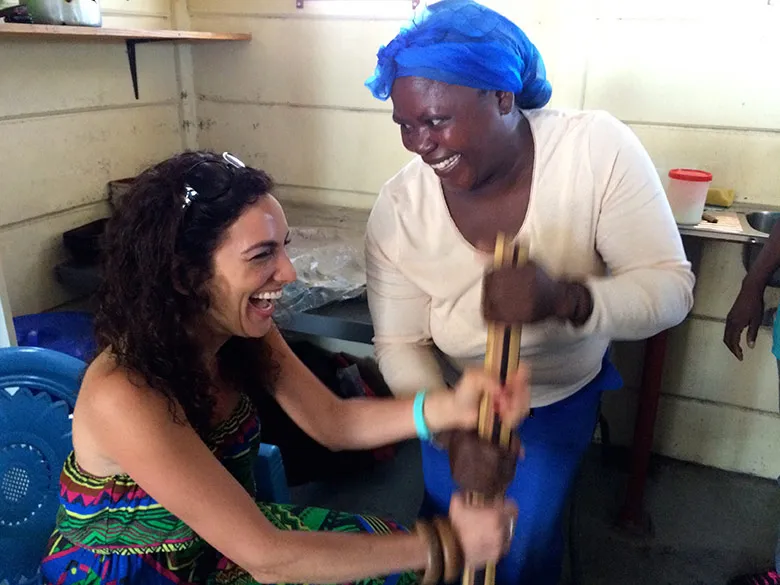
I had the opportunity to pound the sorghum into flour to bake bread. While I often bake at home for my family, I have never done it this way. You can see me laughing in these pictures—but in reality, I was trying really hard to do my job properly! The strenuous process heightened my appreciation of just how hard people in this region of the world work to feed their families. I was told that for every 1.5 kilograms of flour produced, it takes the women almost an hour to grind the grain. Just after several minutes, I felt my arms melt into Jello.
The roots of the community
As I walked up to the family strengthening office in the Village, I noticed a small garden. Through various initiatives such as gardens, bread-baking and career counselling, SOS Family Strengthening Programs prevent child abandonment before it happens. The program provides support to vulnerable families from the surrounding community who are at-risk of separation. This involves a social and economic intervention that allows the family to become resilient and self-reliant.
The gardening program directly benefits families by generating a surplus income from the sale of vegetables. In addition to this income, the garden's crops and vegetables contribute to the families' daily food consumption and particularly benefit young children. The little ones from the SOS Kindergarten also come to the garden to learn about planting trees and caring for plants.
People in Namibia face countless challenges every day that can easily threaten the stability of a family, including food insecurity and a slowly developing health system. For me, it was so touching to learn that an organization like SOS Children's Villages is taking it upon itself to strengthen existing families and keep them together. By helping parents and caregivers start their own businesses, the SOS team helps them regain their confidence and pride in their community. These hard-working parents are also building opportunities for their own children.
You have goat to be kidding me
When I first arrived at the Village, I had no idea I would see so many cows, goats, and stray dogs roaming wild. The cows and goats pay no attention to boundaries; they feel right at home in the Village and go where they please. They don't watch out for traffic either! That's why when travelling by car in the area, you'll often have to stop for them to cross the road and even trail behind them as they slowly travel on it.
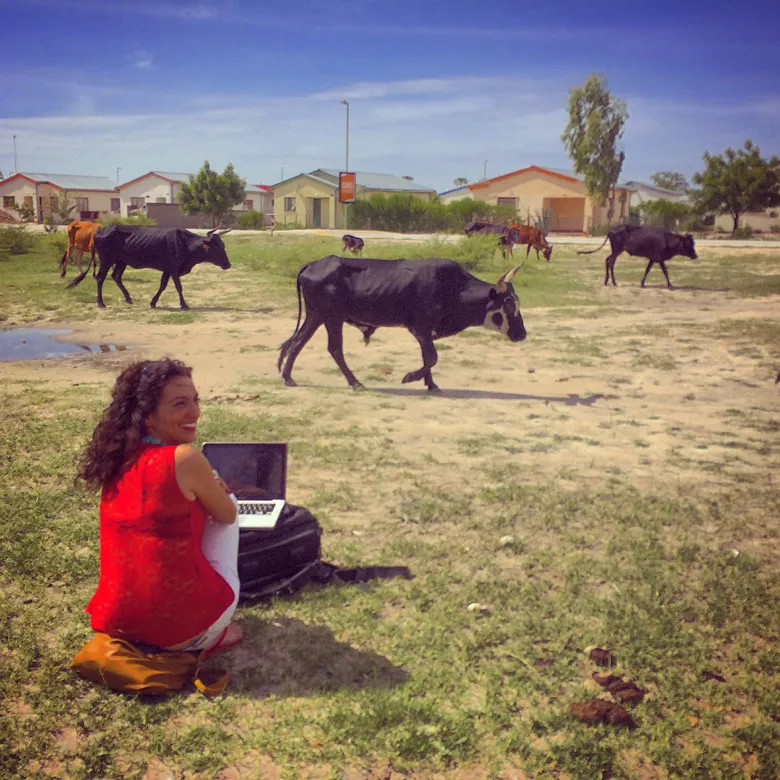
Herds come in waves, grazing right through the Village and not leaving much grass behind. Oddly enough, the cows are awfully quiet in their pursuit of consuming as much grass as possible.
The SOS kids and staff don't give them a second thought, but at the same time, no one seems to go near them. Both sides seem to have achieved a perfect co-existence, and I followed their lead.
A routine helps to raise 8 kids
In many ways, being an SOS mother felt no different from being a mother in Canada. There is something universal about raising and caring for children. But in other ways, my experience in Namibia was quite different from my day-to-day life in Toronto.
Let's start with the fact that I was helping to raise eight children instead of three. It was not easy to give your attention to that many children all at once! So how do the amazing SOS mothers deal with all of the chaos? How do they make each child feel both loved and secure? During my time in Namibia, I learned that SOS mothers rely quite heavily on a daily routine. The children had incredible self-discipline and weren't afraid to help around the house or care for their younger siblings.
I could describe my evenings in Canada as blissfully chaotic. But in Namibia, despite the larger number of children under one roof, there is no screaming or shoving. At my own home with my eldest, who is six years old, we talk about making our bed, but we don't always do it. In Namibia, the children don't think twice about making their beds. It's second nature to them. Routine is essential because, when it becomes a habit, you don't see it as a chore; it is just something you do.
The SOS children wake up at 5:15 a.m., shower, sweep their rooms, eat breakfast, iron their uniforms, pack their lunch snacks and do laundry – all before they head out the door for school! Each child is independent and very self-sufficient, which was a huge help when being a mother to all eight of them.
A communal family
Elizabeth, the SOS mother, involved her children in almost every aspect of running the house. When it was time to make the grocery list, she gathered the family around the table and asked her kids what they would like her to buy. Each child explained what they think needs to be replenished and if they need any personal items, such as new school supplies.
I asked Elizabeth what she does if one of the children asks for a new toy. She said the child has to explain why they need it, and if she agrees, she will ask the SOS head office whether there is a budget to buy the toy. If the answer is no and she still thinks it is a toy the kids need – a new ball, for example – she will often ask the other SOS mothers if they would be willing to pitch in to purchase a communal ball to be shared by the whole Village.
Elizabeth mentioned that she would rather have a communal ball that every child in the Village can use than one bought for a specific child. The concept of purchasing toys for the Village to share was completely new to me, but I loved the idea. I am so used to parents spoiling their kids back home (myself included) and not considering what the other kids in the neighbourhood have.
I plan to suggest to my kids that they take five toys that they no longer use and trade them with five toys their cousins or friends are bored with. In Canada, we have so much and yet it isn't appreciated.
Herding cattle
My time was spent in Namibia, living with my wonderful SOS family and learning what it was like to be an SOS mother. But we were shooting a video as well. We had a great crew, including Graeme and Robert from SOS Children's Villages Canada, and our videographer, Aaron. There aren't a lot of 'behind the scenes' stories (well there are a few, but you would have to have been there to appreciate them!), but there is one that's worth telling.
One Sunday morning, we were outside filming what we called 'stand-ups' where I talked to the camera. Aaron picked a spot facing the SOS Village across the field where the playground and the soccer pitch are. I get into position, we're rolling, and I start to talk… And suddenly we have to stop because there's a herd of cattle coming.
As you may have gathered, it's not uncommon to have cattle roaming all over where we were in Namibia. And I mean all over: they walk on streets, ignoring cars and pedestrians alike.
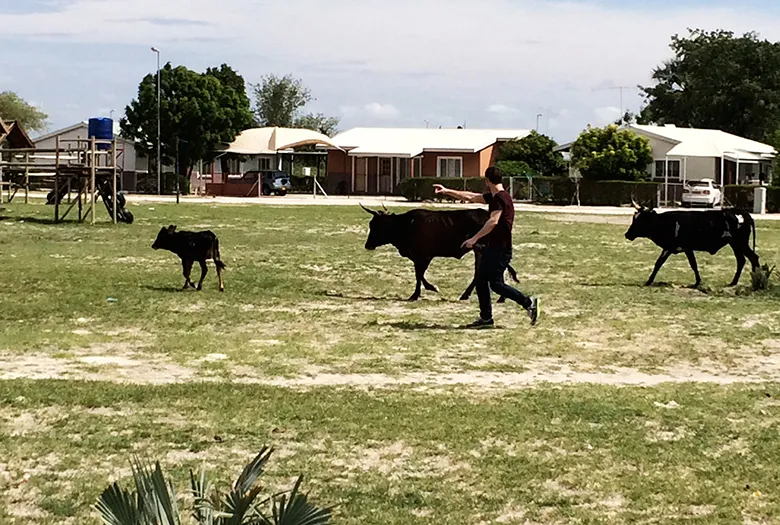
But we're all set up to film. We don't want to move the camera. So… Aaron decides to indulge his inner cowboy. He starts running all over, shooing the cattle away from where we're filming. It's as ridiculous-looking as it sounds. After much coaxing from Aaron, the cows eventually wandered somewhere else. We started to film again. And then the cars started to appear… But even Aaron couldn't herd them.
Cultural differences
When travelling to a new country, cultural differences are inevitable. I knew that there would be some differences, but there were a few things that I was unaware of. For example, I had no idea that Namibians eat their evening oatmeal with their hands. I was all set to put out spoons for the kids when they pointed it out and I felt a little silly for not realizing!
I also learned that Namibians generally don't speak during meals. In my home, dinnertime is when everyone shares how their day went, so I kept asking the SOS children about their day at school. It wasn't until after dinner that I was told why no one was answering me.
Another interesting cultural difference I learned was that you don't just walk up to someone and ask for directions – you first have to make small talk, or the request is seen as rude. I love how, in my father's home country of Mexico, everyone talks to each other, too! They acknowledge everyone they pass in the streets. In Toronto, it feels like life is so much busier, and we tend to always have our eyes on our smartphones. It was refreshing to be in a city where socializing takes priority!
Under African skies
While in Namibia, I did not expect to write any songs. Back home, it is a challenge to find the time to write. Much of my time is spent on the business side of music, performing, running my home, and, of course, my favourite: spending time with my kids! I used to song-write in the evening, but ever since having kids, I no longer have that luxury—I don't want to risk waking anyone up!
During my last few days in Namibia, though, I found myself playing an old guitar that someone had restrung for me. I played some of my songs for the children in the Village. After spending many evenings connecting with these kids through the magic of music, I became inspired to write a song for the family whom I realized I was really going to miss. Usually, a song takes me quite a while to write, but this one came quickly. It was impossible not to find inspiration in this amazing family who had welcomed me so openly and taught me so much!
Saying goodbye eight days after we met was very emotional. But after writing the song Under African Skies, I know I'll always remember what this experience and welcoming these children into my heart meant to me.
Amanda's song, Under African Skies, is now available on iTunes. Proceeds from the song go to SOS Children's Villages Canada.
The rhythm of the day
I might have mentioned this in previous posts, but most afternoons in Namibia, the temperatures peak well above the 30 °C mark. The sweltering heat causes people to slow down their daily activities and retreat into the shade. That's why most of the kids in the SOS village try to complete their house chores before the sun rises at 6:30 a.m. In the home that I visited, their day began around 5 a.m.
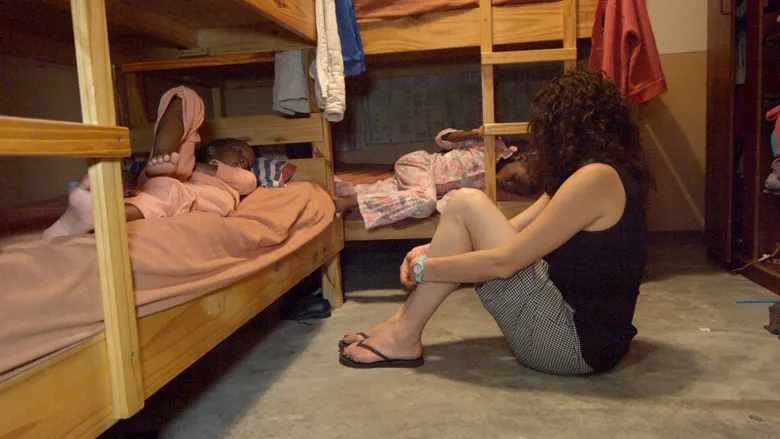
It's fascinating to watch how different cultures adapt to their local climate. Namibia is known for its consistent, harsh heat. We travelled to the country at the start of the rainy season. Since Namibia doesn't yet have the infrastructure for an advanced sewer system and the landscape is very flat, the rainfall had nowhere to go. The land became spotted with large puddles of water.
Back home in Canada, where heating and central air conditioning are readily available, our everyday lives aren't nearly as affected by the weather as those of people in Namibia. We might change our wardrobe with the seasons or recalculate our travel time to work, but the transition is much easier to make. Even though most of us are exposed to bone-chilling temperatures for a significant part of the year, technology allows us to make very few changes to our daily routine. In Namibia, though, the heavy rainfall or extremely high temperatures bring everyone indoors.
With my young children and entrepreneurial lifestyle, I almost never get to slow down in Toronto. But in the SOS Village, whether it was the scorching sun or tap-dancing raindrops that forced us indoors, Namibia's weather created cozy moments of reflection and togetherness.
Maple syrup and ice cream
To say thank you for welcoming me into their home, I decided to cook the family a Canadian meal and dessert. One of my children's favourite dinners is sweet and sour chicken that I make with soy sauce, honey, and maple syrup. My family has dessert after most dinners - something sweet and healthy, such as fruit and a treat on the weekend. Here in Namibia, this is not the case, so I wanted to surprise the family with some homemade chocolate chip oatmeal cookies after dinner.
Only one problem, the grocery store I went to didn't sell soy sauce or chocolate chips. I found a sweet chilli sauce to substitute for soy sauce, and the children loved it.
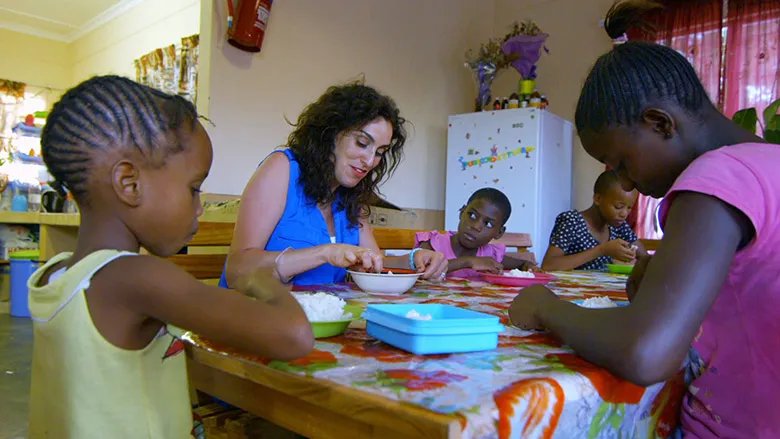
But, who knew finding chocolate chips would be so difficult? Instead of creating more heat in the house by baking, I decided ice cream was the perfect alternative. The children never get ice cream, so it was heartwarming to see the joy on their faces as they slurped it up!
We aren't so different
Although I was halfway around the world, there were many similarities between the SOS home and my own in Toronto.
The biggest difference was the children's morning routines. Elizabeth's children have more responsibility; they are in charge of sweeping their rooms, ironing and doing a load of laundry before they leave in the morning. However, once the children left for school, our routine was almost identical. She prepares dinner mid-morning so it's ready for when the children come home, just as I do. We also share the same cleaning schedule, except she has a whole different process for doing laundry.
One afternoon I took a walk with Elizabeth where I had the chance to ask her a few questions about being an SOS mother. It was interesting how many similarities there are between us as mothers. She explained the challenges she faces as a mother, which are essentially the same ones I deal with in Canada. To handle the chaos, she has a routine. The fun aspects of motherhood are similar too, reading with the kids before bed and helping them with their homework are areas both Elizabeth and I enjoy.
No matter where in the world you are, stress is inevitable as a parent. I think moms everywhere have patience, a sense of humour, and a method to release their stress. Elizabeth talked to me about gardening and jogging with the other SOS moms to relieve stress. I love to jog too. I have never gardened, but now I am inspired to start!
Back home in Canada
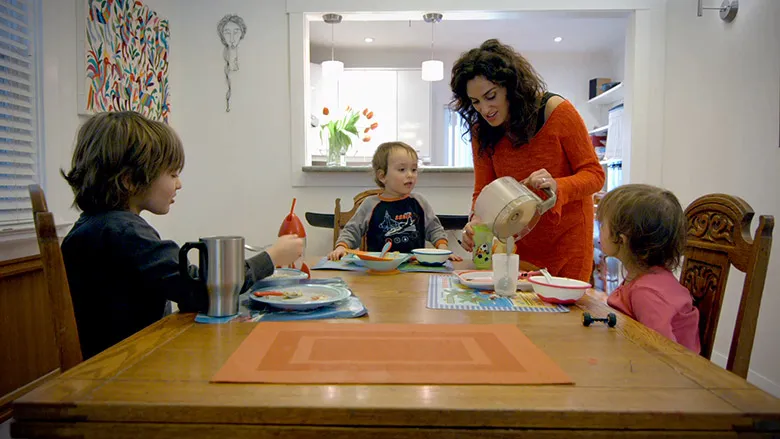
I am integrating much of what I learned from my experience in Namibia into my life in Canada. The SOS house ran so smoothly with eight children. When I saw how well their home routine worked, it confirmed that a routine is essential. I tended to be lenient about my home routine, but after watching Elizabeth, I have realized that sticking to it makes everyone's life so much easier.
After seeing how self-sufficient the entire family was, I have much higher expectations for what my 6-year-old can actually contribute to our household. I have always expected him to clear his plate after meals and make his bed, but now I am asking him to help teach his younger siblings how to do so too. When I tell him the household responsibilities the children in Namibia have, he replies: Oh, I can do that too!