Empowering girls through education in Rwanda: Seraphine’s story for International Women’s Day
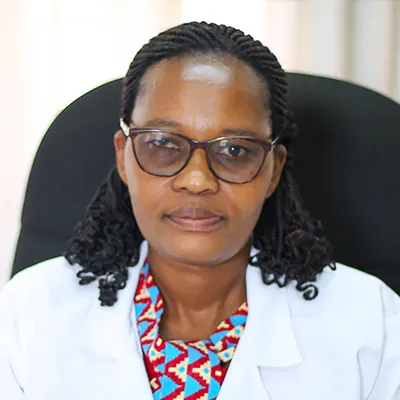
Please share your educational journey.
Despite my difficulties and despite the tendency for girls to be excluded from school, I was very determined. I worked hard from primary up to “eight”. In fact, I passed the National Exams – this was not easy for everyone, and I was the only one from my village to pass.
After the National Exam, my grandfather was unable to afford school fees and school supplies. I was very fortunate to have one of our neighbours support me in getting school materials. At the same time, my uncle (who worked as a cook at a local high school) paid my school fees.
All of this made me work even harder at school. I performed very well from Secondary up to “six”, after which I studied Education Science.
Where did you work before you joined SOS Rwanda?
I think I always knew I wanted to teach. Or be involved in the classroom. I took a job as an Assistant Teacher at the Kigeme Primary School in 1987. I worked there for 6 years, until 2003, when I saw the opportunity at SOS Children's Villages Primary School in Gikongoro, now Nyamagabe District.
Since the first day I began teaching at SOS Primary School, I have been teaching French and English. I feel fortunate to have been part of this school for so long.
Please describe a typical day in your work.
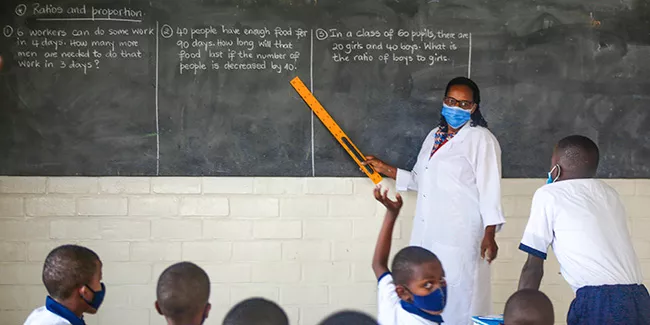
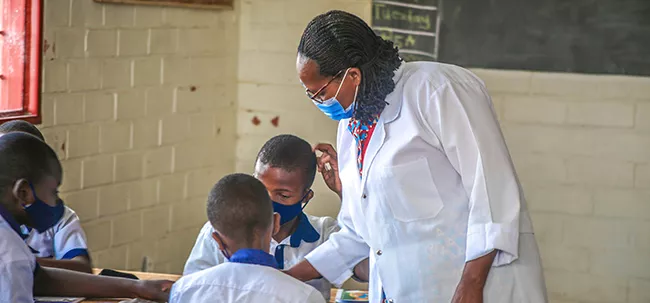
As you know, school days always follow a routine. I start early at 7 am, and I work right up until 5 pm. This involves teaching and preparing lessons, as well as extra activities. For example, before classes, I help students with revision and homework. During break times, I spend time with children from very vulnerable families, providing them with extra support and activities.
Remember, I know what it’s like to be young, hungry, poor, and very interested in learning, and to be at school. So, my days are always about giving all of myself and my attention to students I see struggling.
What are your daily challenges in this role?
Honestly, my daily challenges are not about schoolwork or students' behaviour. My heart breaks only when I see young people come to my classes with empty stomachs.
SOS Children's Villages Primary School receives children from some of the poorest families. And when I see young, hungry children, my heart hurts for them.
But I decided to do something about it. With the help of my fellow teachers, I mobilized a “school breakfast program”. Each of us donates a small amount of money to buy bread and tea for the poorest children who need support and are identified to participate in the program.
What keeps you motivated to continue?
The students – every one of them – keep me motivated day to day. The students are the heart of everything I do as a teacher. I believe that, through them, I am contributing to Rwanda's development. They are the future of this country, so when I teach, I am really supporting a better future for my country, Rwanda.
Please share a fond memory or the best day you’ve had in this role.
I have been teaching for 35 long years, so I have many fond memories of my students. But there is one that stands out in my memory.
I once had to go to the Kanombe Military Hospital for medical treatment, and I was treated by a very kind and professional young doctor. When he told me he was my student years ago at Kigeme Primary School, I was so surprised and happy.
That memory makes me sure that the time I invest in Rwanda’s young people is transformed into each life, into the professions and good work that they choose to do.
What are the key challenges you see for girls and women in Rwanda?
Personally, I know that boys and girls are both capable of doing equally wonderful things and solving all kinds of community problems. But I also know that girls are facing some obstacles, such as unwanted pregnancies, gender discrimination, and sexual violence.
Also, I wish I could tell all families considering pregnancy that they should first consider whether they can provide for or take care of children, including food, shelter, clothing, education, health care, and affection.
What does a “gender-equal” world look like to you?
Gender equality is about equal access to life's opportunities. I do not believe that boys should be privileged at school or in any other activity, simply because they are boys.
In my eyes and my heart, boys and girls are equal, and in a gender-equal world, they would be given the same chances at life.
_______________
About SOS Children’s Villages Rwanda: SOS Children's Villages Rwanda, established in 1979, is a member of the SOS Children's Villages International federation. SOS Rwanda supports children and youth who have lost or who are at risk of losing parental care and provides programming in alternative care, family-based care, family strengthening, child reunification, and youth group homes. Together with local and international organizations, SOS Rwanda improves the lives of vulnerable children, young people, and families by putting their abilities and needs at the center of their work. Learn more: https://www.soscv-rwanda.org.rw