
Green Growth project in Rwanda highlights findings from youth labour market assessment
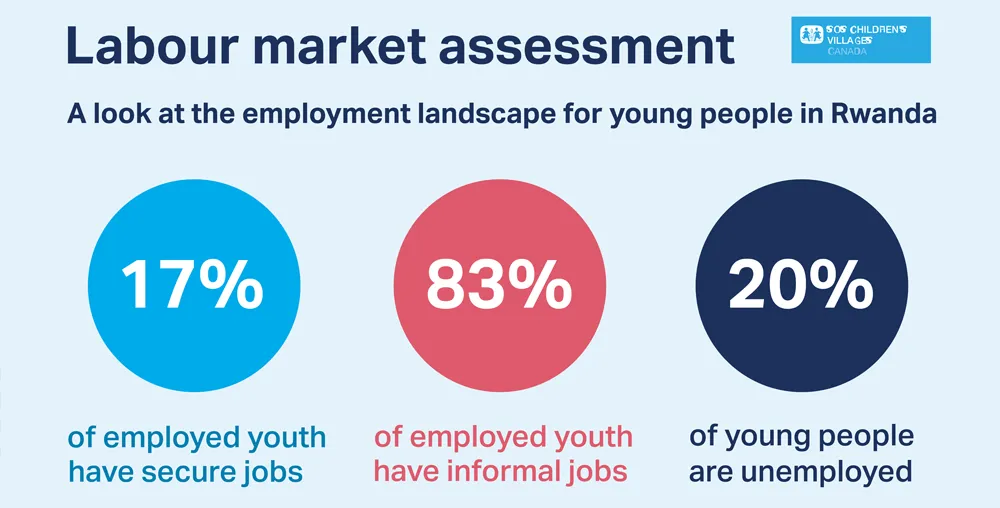
Only 17% of employed young people in Rwanda have secure jobs with stable wages, according to a recent gender-sensitive labour market assessment conducted under the Green Growth: Empowering Youth for a Green Future (Green Growth) project.
The findings highlight significant barriers that prevent many young people from accessing decent employment. The research shows that:
- 83% of employed young people work in informal employment, without contracts, predictable income or social protections.
- 20% of young people are unemployed, with women, young mothers, and people with disabilities facing higher barriers to entering the labour market and securing decent jobs.
To address these challenges, SOS Children’s Villages Rwanda convened a validation meeting to bring together key stakeholders to review and confirm the assessment findings before it is finalized or used for decision-making.
The meeting brought together representatives from government institutions, including the Rwanda Technical and Vocational Education and Training (TVET) Board, the Gender Monitoring Office, the National Council of Persons with Disabilities, youth representatives and private-sector partners.

Equipping young people with skills for the future
Kalenzi Bosco, Head of Projects at SOS Children’s Villages Rwanda, emphasized that the Green Growth project aims to equip young people with practical skills that will help them enter the labour market. He added that collaboration with district authorities will be essential to achieving the project’s goals.
“District officials are key implementers at the local level, and working closely with them will ensure that the project responds to the real needs of young people in the communities we serve,” he explained.

Research highlights labour market barriers
The labour market assessment was conducted by Teddy Kaberuka, Consultant in Research and Policy, and he presented the key findings.
Based on a review of existing reports and field analysis across the five target districts, the research shows that a large proportion of young people remain in informal work, while unemployment continues to disproportionately affect young women.
“We conducted research across the five districts where the Green Growth project will be implemented,” he explained. These include Kayonza, Nyagatare, Gisagara, Gasabo and Bugesera, covering both rural agricultural communities and rapidly growing areas on the outskirts of cities.
The project primarily targets economically disadvantaged young people, with a focus on young women, young people with disabilities, teenage mothers and other young people in situations of vulnerability.
The findings show:
Young women are more likely to be unemployed than young men.
Young people with disabilities have had limited opportunities to access education, including TVET training.
Limited access to practical skills and entrepreneurship support remains a major barrier.
“We have identified several challenges affecting young people’s development. Our focus will be on strengthening their practical skills and supporting them to start small businesses. This will help young people become more self-reliant and improve their livelihoods,” he said.
Why your support matters
Behind the statistics are young people with aspirations for their future. Yet limited access to skills training, decent jobs and entrepreneurship opportunities continues to prevent many from reaching their full potential.
Your support helps young people gain the skills and confidence they need to shape their futures and contribute to stronger communities. Every dollar you contribute is 3X matched, multiplying your impact and maximizing hope.
Green Growth is a five-year initiative launched in 2025 in partnership with the Government of Canada through Global Affairs Canada.