
Haiti three years after the earthquake: Help is working but must not fade
A full three years have passed since Haiti was hit by a massive earthquake on 12 January 2010, yet the country is still dependent on broad international support.
Progress has been made in several areas, but it will take additional financial resources to achieve lasting change for the better. The 2012 hurricanes caused extensive damage and revealed weak spots in both infrastructure and disaster management.
The food situation, in particular, has been a pressing issue ever since. Three years following the devastating earthquake on January 12, 2010, that left hundreds of thousands dead, reconstruction and a certain degree of normality have been achieved in a number of areas.
According to the most recent humanitarian report from the Office for the Coordination of Humanitarian Affairs (OCHA), 358,000 people are still living in tent cities and camps, compared to 1.5 million in 2010, a decline of more than 77 percent.
The relocation programmes will remain the most urgent objective of the cooperation between the Haitian government and humanitarian partners in 2013. The living conditions in the camps have deteriorated even further, a process aided by high crime rates.
A further rise in the number of cholera cases could have been avoided last year, but prevention and treatment of the infectious disease, and therefore sanitation and water supply in rural areas and the camps, will continue to top the agenda of health-related programs.
Tropical Storm Isaac and Hurricane Sandy once again highlighted Haiti’s vulnerability and the importance of an efficient national disaster management system. The UN and the Haitian government are working hard to replace the UN cluster system, which is still coordinating humanitarian relief in certain areas, with national structures.
The food situation of some two million Haitians is far from safe. The heavy rains and flooding during the hurricane season destroyed vast areas of Haiti, further weakening Haitian agriculture. “SOS Children’s Villages must therefore be prepared to recommence providing food supplies in the next months,” says Mario Brusa, director of SOS Children’s Villages Haiti.
The Haitian government, the UN, and international NGOs cite the need for at least 144 million USD in 2013 to ensure basic goods for 1 million of the most impoverished. However, international funding has been declining, and many NGOs have been forced to leave because they can no longer finance their programs.
Even SOS Children’s Villages has had to scrap some projects due to the exploding prices that concern the construction sector in particular, but it was able to realize most of its planned projects.
The government and NGOs have good reason to appeal for continued commitment on a high level: Scaling down the level of help would be tantamount to turning back halfway. Reconstruction after a catastrophe on this scale requires a longer commitment than just three years, when improvements are only starting to become tangible. Much remains to be done before Haiti, the poorest country in the Americas, can hope for any kind of normality, let alone real consolidation.
Inauguration of new projects honours the memory of earthquake victims
This is why SOS Children’s Villages aims to convert emergency relief measures into long-term programmes as a principle and either remains on location as a local organization or cooperates with local partners, such as communities or family initiatives, which then take over the management of these programs.
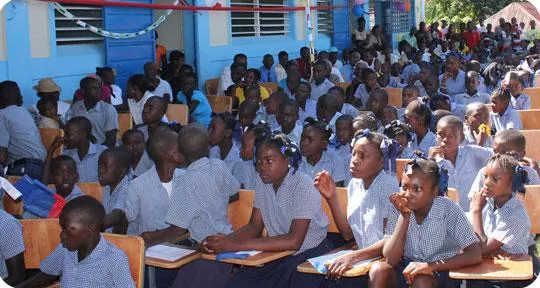
In Haiti, SOS Children’s Villages is doing both. This year’s commemoration of the earthquake’s victims will see the inauguration of four new schools in the South of the country that SOS Children’s Villages either built from scratch or renovated, and that are now being handed over to the public authorities.
In the same region, the laying of the first stone of a new SOS Children's Villages School will take place on January 12. By then, 14 new SOS Families will have moved there – many of the 120 children lost their families in the earthquake.
Practically all projects in Santo in Haiti’s capital, Port-au-Prince, are up and running. Some 100 additional children are still in the care of SOS Children’s Villages. Immediately following the earthquake, hundreds had to be temporarily taken in by existing families until many could return to their own families, but for some, that option is no longer available.
These children will find a new home in the SOS Children’s Village Santo, one of the SOS Families in Cap Haïtien or, in the near future, in Les Cayes. “Very much remains to be done in the areas of child protection or high-quality family-based care for organizations like SOS Children’s Villages,” says Mario Brusa, director of SOS Children’s Villages Haiti. “The social authority IBESR cites some 30,000 Haitian children who require help in this area.”